
Toyota Corolla (E120): On–vehicle inspection
1. Check fuel pump operation
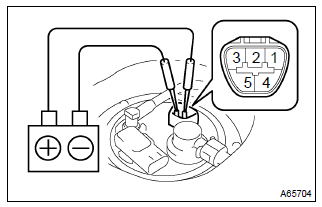
- Connect the hand–held tester to the dlc3.
- turn the ignition switch on and hand–held tester main
switch on.
Notice
: do not start the engine.
- select the active test mode on the hand–held tester.
- please refer to the hand–held tester operator’s manual for further details.
- if you have no hand–held tester, connect the positive (+) lead form the battery to terminal 4 of the connecter, and the negative (–) lead to terminal 5.
Notice
:
- these tests must be done quickly (within 10 seconds) to prevent the coil burning out.
- Keep the fuel pump as far away from the battery as possible.
- Always do the switching at the battery side.
2. Check fuel pressure
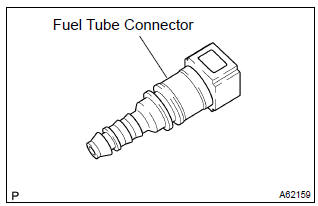
- Prepare for inspection.
- Purchase a new fuel tube, and take out the fuel tube connector from its tube.
Hint
: part no. 23901–0D010
- work for prevent gasoline from spilling out.
- disconnect the efi fuel pipe clamp.
- disconnect the fuel tube from the fuel main tube.
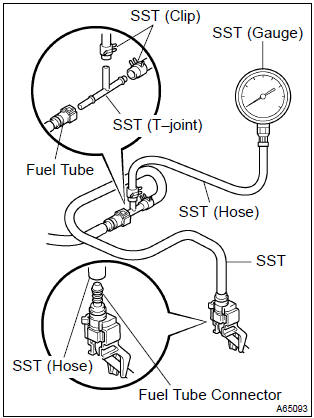
- Install sst (pressure gauge) as shown in the illustration
by using the sst and fuel tube connector.
Sst 09268–41047 (90467–13001, 95336–08070), 09268–45014 (09268–41200, 09268–41220, 09268–41250, 90467–13001)
- wipe off any splattered gasoline.
- ) start the engine.
- measure the fuel pressure at idle.
Fuel pressure: 304 – 343 kpa (3.1 – 3.5 Kgfvcm2, 44 – 50 psi)
- stop the engine.
- check that the fuel pressure remains as specified for 5
minutes after the engine has stopped.
Fuel pressure:
147 kpa (1.5 Kgfvcm2, 21 psi) or more
If pressure is not as specified, check the fuel pump, pressure regulator and/or injectors.
- after checking fuel pressure, disconnect the negative (–) terminal cable from the battery and carefully, remove the sst and fuel tube connector to prevent gasoline from the splashing.
- reconnect the fuel tube to fuel main tube.
- install the efi fuel pipe clamp.
- check fuel leak.


Other materials:
Bluetooth®
■When using the Bluetooth® audio system
●In the following situations, the system may not function.
• The portable player does not support Bluetooth®
• The cellular phone is located outside the service area
• The Bluetooth® device is switched off
• The Bluetooth® device h ...
Circuit description
The side squib (lh) circuit consists of the airbag sensor assy center and
front seat airbag assy (lh).
It causes the srs to deploy when the srs deployment conditions are satisfied.
Dtc b0115/47 is recorded when a short is detected in the side squib (lh)
circuit.
Wiring diagram
...
USB Port/AUX Port
Connect an iPod, USB memory device or portable audio player to the USB/AUX
port as indicated below. Select “iPod”, “USB” or “AUX” on the audio source selection
screen and the device can be operated via multimedia system.
Connecting using the USB/AUX port
■ iPod
Open the cove ...