
Toyota Corolla (E120): Circuit description
Shifting from 1st to o/d is performed in combination with on and off of the shift solenoid valve s1 and s2 controlled by ecm. If an open or short circuit occurs in either of the solenoid valves, the ecm controls the remaining normal solenoid valve to allow the vehicle to be operated smoothly (fail safe function).
Fail safe function: if either of the solenoid valve circuits develops an open or short, the ecm turns the other solenoid valve on and off to shift to the gear positions shown in the table below. If both solenoids malfunction, hydraulic control cannot be performed electronically and must be done manually.
Manual shifting as shown in the above table must be done (in the case of a short circuit, the ecm stops sending current to the short circuited solenoid).
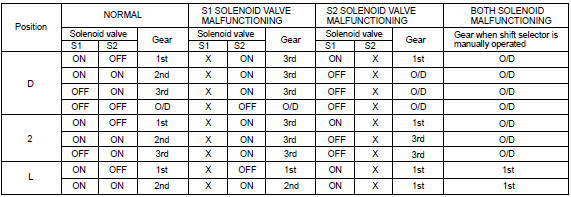
X: malfunctions

Monitor description
The ecm commands gearshift by turning the shift solenoid valves ”on/off”. When there is an open or short circuit in any shift solenoid valve circuit, the ecm detects the problem and the mil comes on. Illuminating the mil, the ecm performs the fail–safe and turns the other shift solenoid valves in good condition ”on/off” (in case of an open or short circuit, the ecm stops sending current to the circuit.).
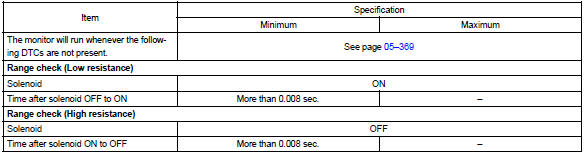
Monitor strategy

Typical enabling condition
Typical malfunction thresholds
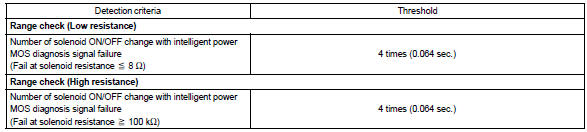
Component operating range

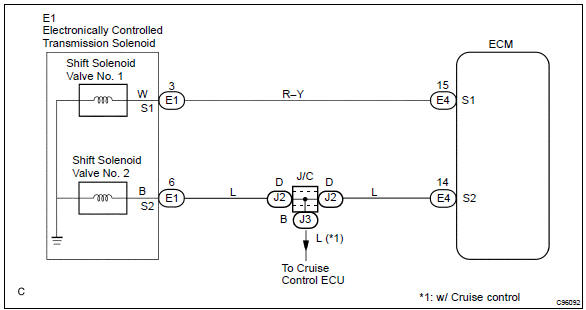
Wiring diagram


Other materials:
Inspection procedure
1 Input signal check
See input signal check on page 05–745.
check the indicator light operation when each of the set/
coast, resume/accel and cancel is turned on.
Ok:
set/coast, resume/accel switch:
the signals shown in the table on the left should be
output when each switch is ...
Abbreviations used in this manual
...
Terminals of ecu
Oscilloscope wave (*1)
Hint:
terminal: od – gnd
gauge set: 5 v / div, 50 ms / div
condition: during cruise control driving o/d switch on.
...