
Toyota Corolla (E120) 2002–2008 Repair Manual / Diagnostics / Sfi system / Intake air temperature circuit / Inspection procedure
Toyota Corolla (E120): Inspection procedure
Hint
:
- if different dtcs related to different systems that have terminal e2 as the ground terminal are output simultaneously, terminal e2 may be open.
- Read freeze frame data using the hand-held tester or the obd ii scan tool. Freeze frame data records the engine conditions when a malfunction is detected. When troubleshooting, it is useful for determining whether the vehicle was running or stopped, the engine was warmed up or not, the air–fuel ratio was lean or rich, etc. At the time of the malfunction.
1 Read value of hand–held tester or obd ii scan tool(intake air temperature)
- Connect the hand–held tester or the obd ii scan tool to the dlc3.
- turn the ignition switch on and push the hand–held tester or the obd ii scan tool main switch on.
- select the item ”diagnosis / enhanced obd ii / data list / all / intake air” and read its value displayed on the hand–held tester or the obd ii scan tool.
Temperature: same value as the actual intake air temperature.
Result:

Hint
:
- if there is an open circuit, the hand–held tester or the obd ii scan tool indicates –40 °C (–40°f).
- If there is a short circuit, the hand–held tester or the obd ii scan tool indicates 140 °C (284°f) or more.

2 Read value of hand–held tester or obd ii scan tool(check for open in wire harness)
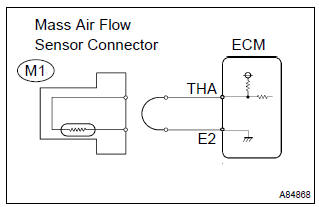
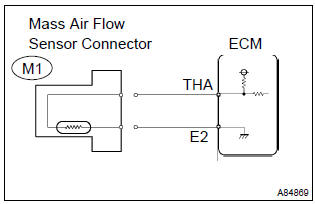
- Disconnect the m1 mass air flow sensor connector
- connect terminals tha and e2 of the mass air flow sensor wire harness side connector.
- turn the ignition switch on.
- select the item ”diagnosis / enhanced obd ii /
data list / all / intake air” and read its value displayed
on the hand–held tester or the obd ii scan tool.
Temperature value: 140 °C (284°f) or more
- reconnect the mass air flow sensor connector.
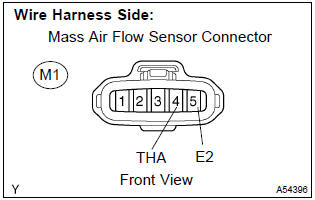


3 Read value of hand–held tester or obd ii scan tool(check for open in ecm)
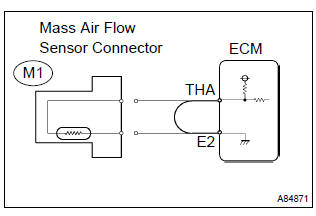
- Disconnect the m1 mass air flow sensor connector.
- connect the terminals tha and e2 of the e3 ecm connector.
Hint
: before checking, do a visual and contact pressure check on the ecm connector.
- turn the ignition switch on.
- select the item ”diagnosis / enhanced obd ii /
data list / all / intake air” and read its value displayed
on the hand–held tester or the obd ii scan tool.
Temperature value: 140 °C (284°f) or more
- reconnect the mass air flow sensor connector.
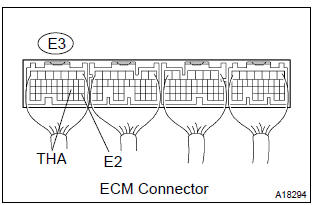


Confirm good connection at ecm. If ok, replace ecm
4 Read value of hand–held tester or obd ii scan tool(check for short in wire harness)
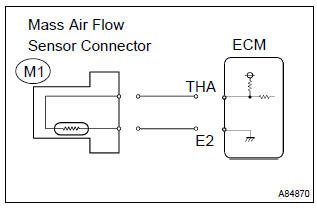
- Disconnect the m1 mass air flow sensor connector.
- turn the ignition switch on.
- select the item ”diagnosis / enhanced obd ii /
data list / all / intake air” and read its value displayed
on the hand–held tester or the obd ii scan tool.
Temperature value: –40 °C (–40°f)
- reconnect the mass air flow sensor connector.


5 Read value of hand–held tester or obd ii scan tool(check for short in ecm)
- Disconnect the e3 ecm connector.
- turn the ignition switch on.
- select the item ”diagnosis / enhanced obd ii /
data list / all / intake air” and read its value displayed
on the hand–held tester or the obd ii scan tool.
Temperature value: –40 °C (–40°f)
- reconnect the ecm connector.
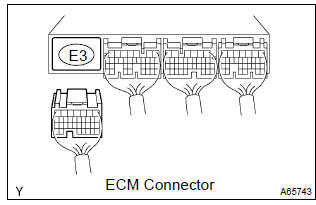


Replace ecm


Other materials:
Bluetooth® audio/phone
The following can be performed using Bluetooth® wireless communication:
■ Bluetooth® audio
The Bluetooth® audio system enables you to enjoy music played on a portable
player from the vehicle speakers via wireless communication.
This audio system supports Bluetooth®, a wireless data sy ...
Riding with children
Observe the following precautions
when children are
in the vehicle.
Use a child restraint system
appropriate for the child,
until the child becomes
large enough to properly
wear the vehicle's seat belt.
It is recommended that children
sit in the rear seats to
avoid accidental contact
with the ...
Antenna cord sub–assy
Replacement
Hint: components:
1. Remove instrument panel sub–assy upper
Hint:
refer to the procedure until the step, ”remove instrument panel sub–assy
upper” of
instrument panel sub–assy lower.
Remove the related parts as long as the antenna cord sub–assy can be
removed ...