
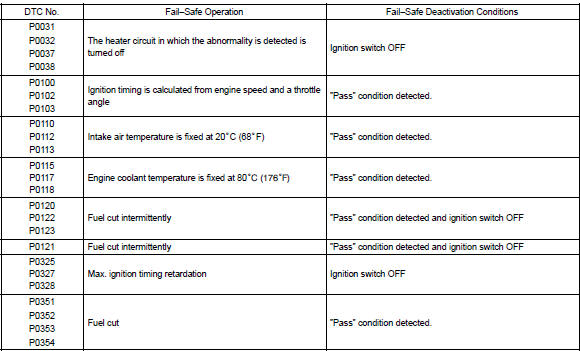
Toyota Corolla (E120): Fail–safe chart
If any of the following codes is recorded, the ecm enters the fail–safe mode.
Check for intermittent problems
Hand–held tester only:
by putting the vehicle’s ecm in the check mode, the 1 trip detection logic is possible instead of the 2 trip detection logic, and the sensitivity to detect faults is increased. This makes it easier to detect intermittent problems.
- Clear the dtcs .
- set the check mode .
- perform a simulation test .
- check the connector and terminal .
- wiggle the harness and connector


Other materials:
Cleaning and protecting the vehicle exterior
Perform cleaning in a manner
appropriate to each
component and its material.
Cleaning instructions
Working from top to bottom,
liberally apply water to the
vehicle body, wheel wells and
underside of the vehicle to
remove any dirt and dust.
Wash the vehicle body using
a sponge or soft cloth, ...
Listening to a USB memory device
Connecting a USB memory device enables you to enjoy music from the vehicle
speakers.
Touch “USB” on the audio source selection screen.
Connecting a USB memory device
Audio control screen
Pressing the “AUDIO” button displays the audio control screen from any screens
of the selected so ...
Circuit description
If the engine coolant temperature (ect) does not reach 75°c (167°f) despite
sufficient warm – up time has
elapsed.
Dtc no
Dtc detection condition
Trouble area
P0128
Condition (a), (b) and (c):
cold start
after engine is warmed up
& ...