
Toyota Corolla (E120): On–vehicle inspection
1. Inspect brake booster
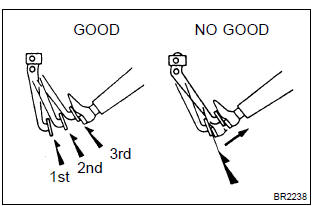
- Airtightness check.
- Start the engine and stop it after 1 or 2 minutes. Depress
the brake pedal several times slowly.
Hint
: if the pedal goes down farthest at the 1st time, but gradually rises after the 2nd or 3rd time, the booster is airtight.
- Depress the brake pedal while the engine is running,
and stop the engine with the pedal depressed.
Hint
: if there is no change in the pedal reserve distance after holding the pedal for 30 seconds, the booster is airtight.
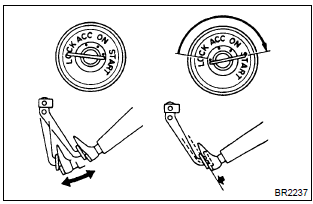
- Operating check.
- Depress the brake pedal several times with the ignition switch off and check that there is no change in the pedal reserve distance.
- Depress the brake pedal and start the engine.
Hint
: if the pedal goes down slightly, operation is normal.
2. Inspect vacuum check valve
- check vacuum check valve.
- Slide the clip and disconnect the vacuum hose.
- Remove the vacuum check valve.
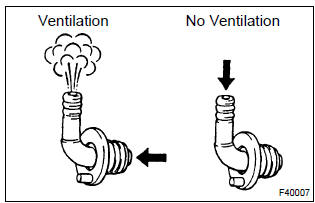
- Check that there is ventilation from the booster to engine, and no ventilation from the engine to the booster.
- If any fault is found, replace the vacuum check valve.


Other materials:
Inspection procedure
Hint:
read freeze frame data using the hand-held tester or the obd ii scan tool.
Freeze frame data records the
engine conditions when a malfunction is detected. When troubleshooting, it is
useful for determining whether
the vehicle was running or stopped, the engine was warmed up or not, the ...
Replacement
1. Work for preventing gasoline from spilling out
2. Remove front wheels
3. Remove engine under cover rh
4. Remove engine under cover lh
5. Drain coolant
6. Remove cylinder head cover no.2
Remove the 2 nuts, 2 clips and cylinder head cover.
7. Disconnect radiator hose inlet
&nb ...
Circuit description
The ignition switch provides circuit power and the ecm provides the circuit
ground that illuminates the mil.
Mil operation is checked visually:
it should be illuminated when the ignition is first turned on. If the mil is off
all of the time or on all of the time,
use the procedure below to ...