
Toyota Corolla (E120) 2002–2008 Repair Manual / Diagnostics / Sfi system / Ignition coil primary/secondary
circuit / Circuit description
Toyota Corolla (E120): Circuit description
Hint
:
- these dtcs indicate a malfunction related to the primary circuit.
- If dtc p0351 is displayed, check the no.1 Ignition coil with igniter circuit.
- If dtc p0352 is displayed, check the no.2 Ignition coil with igniter circuit.
- If dtc p0353 is displayed, check the no.3 Ignition coil with igniter circuit.
- If dtc p0354 is displayed, check the no.4 Ignition coil with igniter circuit.
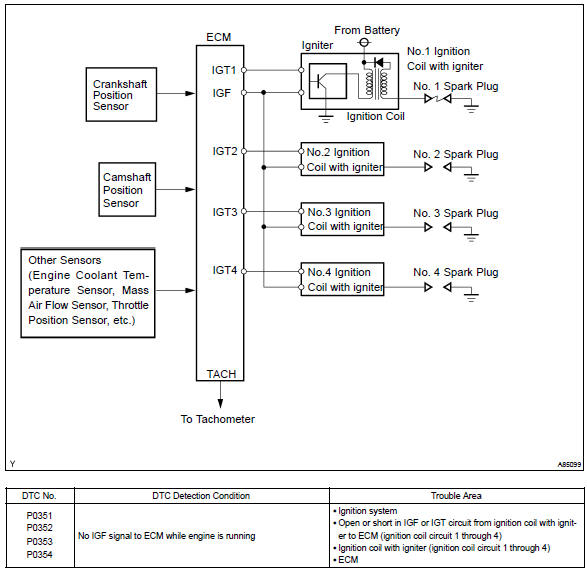
A direct ignition system (dis) is used on this vehicle. The dis improves the ignition timing accuracy, reduces high–voltage loss, and enhances the overall reliability of the ignition system by eliminating the distributor.
The dis is a 1–cylinder ignition system which ignites one cylinder with one ignition coil. In the 1–cylinder ignition system, the one spark plug is connected to the end of the secondary winding. High voltage generated in the secondary winding is applied directly to the spark plug. The spark of the spark plug passes from the center electrode to the ground electrode.
The ecm determines the ignition timing and outputs the ignition signals (igt) for each cylinder. Using the ignition (igt) signal, the ecm turns on and off the power transistor inside the igniter and this switches on and off the current to the primary coil. When the current flow to the primary coil is cut off, high–voltage is generated in the secondary coil and this voltage is applied to the spark plugs to spark inside the cylinders.
As the ecm cuts the current to the primary coil, the igniter sends back the ignition confirmation (igf) signal for each cylinder ignition to the ecm.
Monitor description
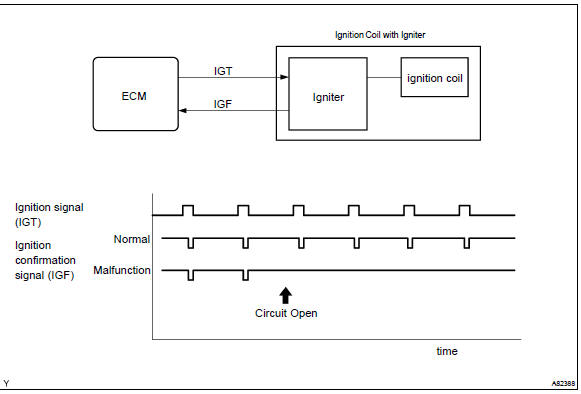
If the ecm does not receive the ignition confirmation signal (igf) after sending the ignition signal (igt), it interprets this as a fault in the igniter and sets a dtc.
Monitor strategy
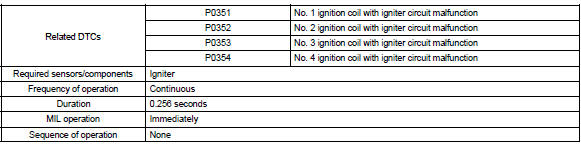
Typical enabling conditions
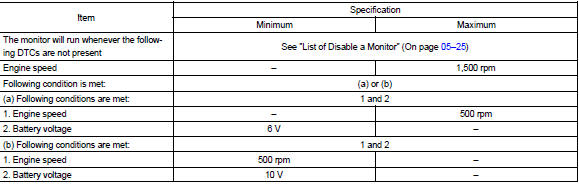
Typical malfunction thresholds

Component operating range

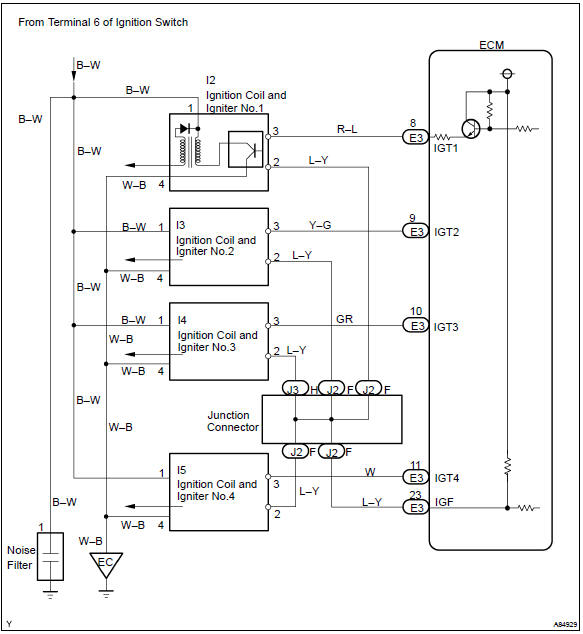
Wiring diagram


Other materials:
Steering wheel audio switches
Some audio features can be controlled using the switches on the steering wheel.
Operation may differ depending on the type of audio system or navigation system.
For details, refer to the manual provided with the audio system or navigation system.
Operating the audio system using the steering whe ...
Inspection procedure
1 Check voltage at ig2 of airbag sensor assy center
Disconnect the negative (–) terminal cable from the battery,
and wait at least for 90 seconds.
disconnect the connector of the airbag sensor assy center.
connect the negative (–) terminal cable to the battery,
and wa ...
Circuit description
The camshaft position sensor (g22+ signal) consists of a magnet, iron core
and pickup coil.
The g22+ signal plate has 3 teeth on its outer circumference and is installed on
the camshaft timing pulley.
When the camshafts rotate, the protrusion on the signal plate and the air gap on
the pi ...