
Toyota Corolla (E120) 2002–2008 Repair Manual / Diagnostics / Sfi system / Throttle/pedal position
sensor/switch ”a” circuit / Circuit description
Toyota Corolla (E120): Circuit description
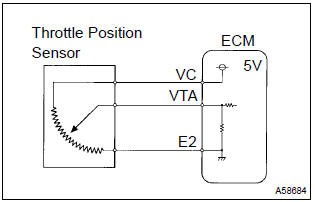
The throttle position sensor is mounted in the throttle body and detects the throttle valve opening angle.
When the throttle valve is fully closed, a voltage of approximately 0.3 To 1.0 V is applied to terminal vta of the ecm. The voltage applied to terminal vta of the ecm increases in proportion to the opening angle of the throttle valve and becomes approximately 3.2 To 4.9 V when the throttle valve is fully opened. The ecm judges the vehicle driving conditions from these signals input from terminal vta, uses them as one of the conditions for deciding the air–fuel ratio correction, power increase correction and fuel–cut control etc.
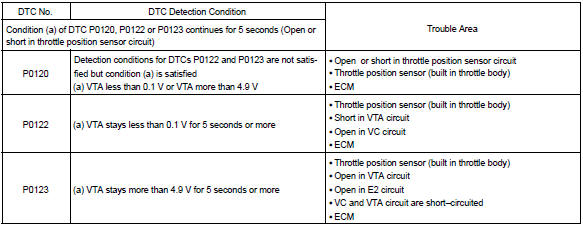
Hint
: after confirming dtcs, confirm the throttle valve opening percentage and closed throttle position switch condition using the hand–held tester or the obd ii scan tool.

Monitor description
The throttle position sensor varies its resistance with the throttle valve angle. The ecm applies a regulated reference voltage to the throttle position sensor “+: vc” terminal and calculates the angle of the throttle valve based on the voltage present at the throttle position sensor “signal: vta” terminal.
When the throttle valve is near the fully closed position, the output voltage of the throttle position sensor is low. When it is near the fully open position, the output voltage is high.
If the ecm detects that the output voltage of the throttle position sensor is out of the normal range, the ecm interprets this as a malfunction in the throttle position sensor and sets a dtc.
Monitor strategy
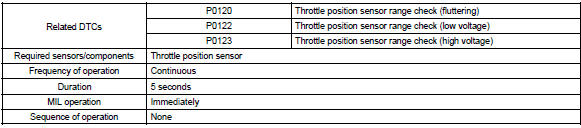
Typical enabling condition

Typical malfunction thresholds

Component operating range

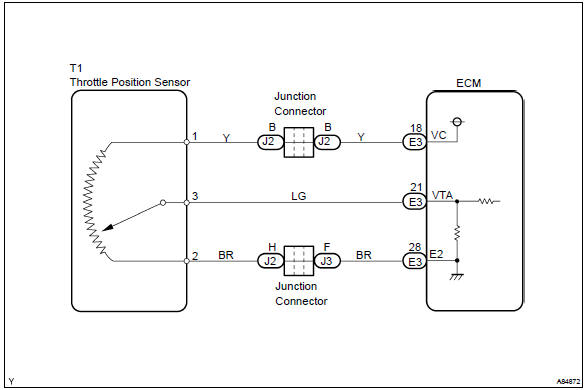
Wiring diagram


Other materials:
Inspection procedure
1 Check relay (marking: starter cut)
Inspect the relay continuity, as shown in the illustration
and table.
Standard:
2 Check tvip ecu
Disconnect the tvip ecu connector.
turn the ignition switch position to the start.
measure the voltage between the termina ...
Child restraint system
fixed with a seat belt
A child restraint system for a
small child or baby must itself be
properly restrained on the seat
with the lap portion of the
lap/shoulder belt.
■ Installing child restraint
system using a seat belt
(child restraint lock function
belt)
Install the child restraint system
in accordance to the operat ...
Warning lights
Warning lights inform the driver of malfunctions in the indicated vehicle’s systems.
*1: Vehicles without a smart key system:
These lights turn on when the engine switch is turned to the “ON” position to indicate
that a system check is being performed. They will turn off after the engi ...