
Toyota Corolla (E120) 2002–2008 Repair Manual / Diagnostics / Sfi system / Diagnosis system / Check dlc3
Toyota Corolla (E120): Check dlc3
The vehicle’s ecm uses the iso 9141–2 for communication protocol. The terminal arrangement of the dlc3 complies with sae j1962 and matches the iso 9141–2 format.
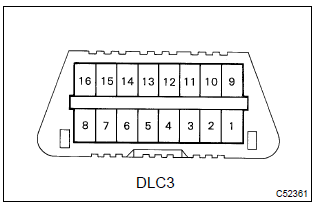

Hint
: if the display shows unable to connect to vehicle when you have connected the cable of the obd ii scan tool or the hand–held tester to the dlc3, turned the ignition switch on and operated the scan tool, there is a problem on the vehicle side or tool side.
- If the communication is normal when the tool is connected to another vehicle, inspect the dlc3 on the original vehicle.
- If the communication is still impossible when the tool is connected to another vehicle, the problem is probably in the tool itself, so consult the service department listed in the tool’s instruction manual.
Inspect battery voltage
Battery voltage: 11 to 14 v
If voltage is below 11 v, recharge the battery before proceeding.
Check mil
- The mil comes on when the ignition switch is turned on
and the engine is not running.
Hint
: if the mil is not illuminated, troubleshoot the mil circuit .
- when the engine is started, the mil should go off. If the mil remains on, it means that the diagnosis system has detected a malfunction or abnormality in the system.


Other materials:
PCS (Pre-Collision System)
The pre-collision system
uses sensors to detect
objects in the path
of the vehicle. When the
system determines that the
possibility of a frontal collision
with a detectable
object is high, a warning
operates to urge the driver
to take evasive action and
the potential brake pressure
is increased to h ...
Coolant
Replacement
1. Drain coolant
Caution:
to avoid the danger of being burned, do not remove the radiator
cap while the engine and radiator are still hot, as fluid
and steam can be blown out under pressure.
remove the radiator cap.
loosen the radiator and engine drain plugs, a ...
Locking the doors from the outside without a key
1 Move the inside lock button to the lock position.
2 Close the door.
► Vehicles without a smart key system
The door cannot be locked if either of the front doors is open and the key is in
the engine switch.
► Vehicles with a smart key system
The door cannot be locked if the engin ...