
Toyota Corolla (E170) 2014–2019 Owners Manual / Driving / Driving procedures / Engine (ignition) switch (vehicles without a smart key system) / Changing the engine switch positions
Toyota Corolla (E170): Changing the engine switch positions
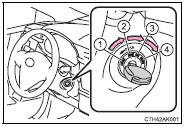
1 “LOCK”
The steering wheel is locked and the key can be removed. (Vehicles with an automatic
transmission or continuously variable transmission: The key can be removed only
when the shift lever is in P.) 2 “ACC”
Some electrical components such as the audio system can be used.
3 “ON”
All electrical components can be used.
4 “START”
For starting the engine.
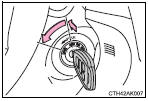
■Turning the key from “ACC” to “LOCK”
1 Shift the shift lever to P (automatic transmission or continuously variable transmission) or N (manual transmission).
2 Push in the key and turn it to the “LOCK” position.
■If the engine does not start
The engine immobilizer system may not have been deactivated. Contact your Toyota dealer.
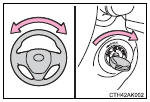
■When the steering lock cannot be released
When starting the engine, the engine switch may seem stuck in the “LOCK” position. To free it, turn the key while turning the steering wheel slightly left and right.
■Key reminder function
A buzzer sounds if the driver’s door is opened while the engine switch is in the “LOCK” or “ACC” position to remind you to remove the key.
CAUTION
■When starting the engine
Always start the engine while sitting in the driver’s seat. Do not depress the accelerator pedal while starting the engine under any circumstances.
Doing so may cause an accident resulting in death or serious injury.
■Caution when driving
Do not turn the engine switch to the “LOCK” position while driving. If, in an emergency, you must turn the engine off while the vehicle is moving, turn the engine switch only to the “ACC” position to stop the engine. An accident may result if the engine is stopped while driving.
■To prevent battery discharge
Do not leave the engine switch in the “ACC” or “ON” position for long periods of time without the engine running.
■When starting the engine
●Do not crank the engine for more than 30 seconds at a time. This may overheat the starter and wiring system.
●Do not race a cold engine.
●If the engine becomes difficult to start or stalls frequently, have your vehicle checked by your Toyota dealer immediately.


Other materials:
Inspection procedure
Hand–held tester:
1 Check operation of stop light
Check if the stop lights go on and off normally when the brake pedal is
depressed and released.
2 Inspect stop light switch assy
Check the resistance between the terminals when the
switch is turned on and off.
Standard:
...
Purpose of the readiness tests
The on–board diagnostic (obd ii) system is designed to monitor the
performance of emission–related
components and report any detected abnormalities in the form of diagnostic
trouble codes
(dtcs). Since the various components need to be monitored during different
driving condition ...
Brake Hold
The brake hold system
keeps the brake applied
when the shift lever is in D,
B (vehicles without paddle
shift switches), M (vehicles
with paddle shift switches)
or N with the system on and
the brake pedal has been
depressed to stop the vehicle.
The system releases the
brake when the accelerator
peda ...