
Toyota Corolla (E170) 2014–2019 Owners Manual / Driving / Driving procedures / Automatic transmission / Shift position uses
Toyota Corolla (E170): Shift position uses
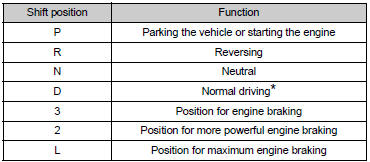
*: Shifting to the D position allows the system to select a gear suitable for driving conditions. Setting the shift lever to the D position is recommended for normal driving.
■Downshifting restrictions
The shift lever cannot be downshifted if the following speeds are exceeded.
mph (km/h)

■When driving with cruise control activated (if equipped)
Even when performing the following actions with the intent of enabling engine braking, engine braking will not activate while downshifting to 3 because cruise control will not be canceled.
■If the shift lever cannot be shifted from P
■AI-SHIFT
AI-SHIFT automatically selects the suitable gear according to driver performance and driving conditions.
AI-SHIFT automatically operates when the shift lever is in the D position.
CAUTION
■When driving on slippery road surfaces
Be careful of downshifting and sudden acceleration, as this could result in the vehicle skidding to the side or spinning.


Other materials:
Inspection procedure
1 Check p/t squib(rh) circuit(airbag sensor assy center – front
seat outer belt assy rh)
Disconnect the negative (–) terminal cable from the battery,
and wait at least for 90 seconds.
disconnect the connectors between the airbag sensor
assy center and the seat belt pretensio ...
Unlocking and locking the doors from the inside
◆ Door lock switches
1 Locks all the doors
2 Unlocks all the doors
◆ Inside lock buttons
1 Locks the door
2 Unlocks the door
The front doors can be opened by pulling the inside handle even if the lock buttons
are in the lock position.
...
Malfunction in speedometer
Wiring diagram
Inspection procedure
1 Check combination meter assy
Remove the combination meter assy with connector still
connected.
check voltage.
Jack up either of the front wheels.
Shift the shift lever to neutral.
Turn the ignition switch to on ...