
Toyota Corolla (E210) 2019-2026 Owners Manual / Driving / Driving procedures / Changing gears in the M
position
Toyota Corolla (E210): Changing gears in the M position
To enter 10-speed sport sequential shiftmatic mode, shift the shift lever to M position.
Gear steps can then be selected by operating the shift lever or paddle shift switches, allowing you to drive in the gear step of your choosing.
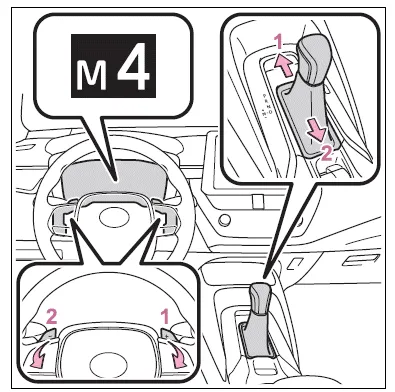
- Upshifting
- Downshifting
The gear changes once every time the shift lever or paddle shift switch is operated.
The selected gear step, from M1 to M10, will be displayed on the multi-information display.
However, even when in the M position, the gear steps will be automatically changed if the engine speed is too high, or too low.
■Gear step functions
- You can choose from 10 levels of engine braking force.
- A lower gear step will provide greater engine braking force than a higher gear step, and the engine speed will also increase.
■When the vehicle comes to a stop with the shift lever in the M position
- The transmission will automatically downshift to M1 once the vehicle is stopped.
- After a stop, the vehicle will start off in M1.
- When the vehicle is stopped, the transmission is set at M1.
■Downshifting restriction warning buzzer
To help ensure safety and driving performance, downshifting operation may sometimes be restricted. In some circumstances, downshifting may not be possible even when the shift lever or paddle shift switch is operated. (A buzzer will sound twice.)
■If the 10-speed sport sequential shiftmatic mode indicator does not come on even after shifting the shift lever to M
This may indicate a malfunction in the continuously variable transmission system. Have the vehicle inspected by your Toyota dealer immediately.
(In this situation, the transmission will operate in the same manner as when the shift lever is in D.)
■Continuously variable transmission fail-safe control
The system detects malfunctioning parts targeted (all of the solenoids that perform the shifting function) by the On-Board Diagnostics, and performs fail-safe mechanisms, such as restricting the shifting function or transmission ratio control.
In this event, the malfunction indicator lamp turns on.


Other materials:
Circuit description
The vapor pressure sensor and the vsv for the canister closed valve (ccv) are
used to detect abnormalities
in the evaporative emission control system. The ecm decides whether there is an
abnormality in the evaporative
emission control system based on the vapor pressure sensor signal.
Dtc p0 ...
Inspection
1. Thermostat
Hint:
the thermostat is numbered with the valve opening temperature.
Immerse the thermostat in water and gradually heat the
water.
check the valve opening temperature.
Valve opening temperature:
80 to 84 c (176 to 183 f)
Hint:
if the valve opening temperatur ...
If your vehicle has to be stopped in an emergency
Only in an emergency, such as if it becomes impossible to stop the vehicle
in the normal way, stop the vehicle using the following procedure:
1 Steadily step on the brake pedal with both feet and firmly depress it.
Do not pump the brake pedal repeatedly as this will increase the effort required ...