
Toyota Corolla (E170) 2014–2019 Owners Manual / When trouble arises / Essential information / If your vehicle has to be stopped in an emergency
Toyota Corolla (E170): If your vehicle has to be stopped in an emergency
Only in an emergency, such as if it becomes impossible to stop the vehicle in the normal way, stop the vehicle using the following procedure:
1 Steadily step on the brake pedal with both feet and firmly depress it.
Do not pump the brake pedal repeatedly as this will increase the effort required to slow the vehicle.
2 Shift the shift lever to N.
► If the shift lever is shifted to N
3 After slowing down, stop the vehicle in a safe place by the road.
4 Stop the engine.
► If the shift lever cannot be shifted to N
3 Keep depressing the brake pedal with both feet to reduce vehicle speed as much as possible.
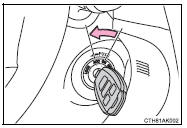
4 Vehicles without a smart key system: Stop the engine by turning the engine switch to the “ACC” position.
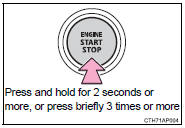
4 Vehicles with a smart key system: To stop the engine, press and hold the engine switch for 2 consecutive seconds or more, or press it briefly 3 times or more in succession.
5 Stop the vehicle in a safe place by the road.
CAUTION
■If the engine has to be turned off while driving
●Power assist for the brakes and steering wheel will be lost, making the brake pedal harder to depress and the steering wheel heavier to turn.
Decelerate as much as possible before turning off the engine.
●Vehicles without a smart key system: Never attempt to remove the key, as doing so will lock the steering wheel.


Other materials:
Circuit description
The door key lock and unlock switch is built in the door lock motor.
Wiring diagram
Inspection procedure
1 Check door lock
2 Check wire harness (tvip ecu door lock)
Disconnect the tvip ecu and door lock connectors.
check the continuity between the terminals of the t ...
Inspection procedure
1 Inspect transmission wire(slt)
Disconnect the transmission wire connector from the
transaxle.
measure the resistance according to the value(s) in the
table below.
Standard:
Measure the resistance according to the value(s) in the
table below.
Standard (check for short):
...
Bluetooth® Audio (Multimedia system)
Listening to Bluetooth® Audio
The Bluetooth® audio system enables the user to enjoy music played on a portable
player from the vehicle speakers via wireless communication.
When a Bluetooth® device cannot be connected, check the connection status on
the “Bluetooth* Audio” screen. If the ...