
Toyota Corolla (E170): Indicators
The indicators inform the driver of the operating state of the vehicle’s various systems.
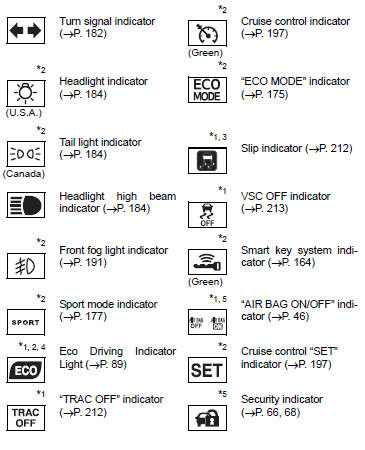
*1: Vehicles without a smart key system: These lights turn on when the engine switch is turned to the “ON” position to indicate that a system check is being performed. They will turn off after the engine is started, or after a few seconds. There may be a malfunction in a system if a light does not come on, or if the lights do not turn off. Have the vehicle inspected by your Toyota dealer.
Vehicles with a smart key system: These lights turn on when the engine switch is turned to IGNITION ON mode to indicate that a system check is being performed. They will turn off after the engine is started, or after a few seconds. There may be a malfunction in a system if a light does not come on, or if the lights do not turn off. Have the vehicle inspected by your Toyota dealer.
*2: If equipped
*3: The light flashes to indicate that the system is operating.
*4: The light does not turn on when the system is disabled.
*5: This light illuminates on the center panel.
CAUTION
■If a safety system warning light does not come on
Should a safety system light such as the ABS and SRS warning lights not come on when you start the engine, this could mean that these systems are not available to help protect you in an accident, which could result in death or serious injury. Have the vehicle inspected by your Toyota dealer immediately if this occurs.


Other materials:
Overhaul
Hint: component:
1. Discharge refrigerant from refrigeration system
sst 07110–58060 (07117–58080, 07117–58090, 07117–78050, 07117–88060,
07117–88070,
07117–88080)
2. Disconnect cooler refrigerant suction hose no.1
Install sst to piping clamp.
Sst 09870–00015
Hint ...
Warning lights and indicators
The warning lights and indicators on the instrument cluster,
center panel, overhead console and outside rear view mirrors inform the driver
of the status of the vehicle's various systems.
Warning lights and indicators displayed on the instrument
cluster
For the purpose of explanation, the followin ...
Pressing power switch does not start system
Wiring diagram
Inspection procedure
1 Inspect radio receiver assy(+b, acc, gnd)
Check that the continuity between terminals at each
condition, as shown in the chart.
Standard:
Check that the voltage between terminals at each condition,
as shown in the chart.
Standard:
...