
Toyota Corolla (E120) 2002–2008 Repair Manual / Cooling / Coolant
Toyota Corolla (E120): Coolant
Replacement
1. Drain coolant
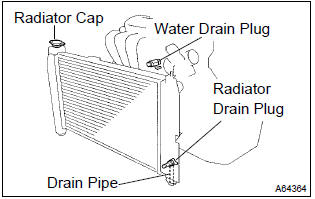
Caution
: to avoid the danger of being burned, do not remove the radiator cap while the engine and radiator are still hot, as fluid and steam can be blown out under pressure.
- remove the radiator cap.
- loosen the radiator and engine drain plugs, and drain the coolant.
- close the drain plugs.
Torque: 13 nvm (130 Kgf·cm, 9 ft·lbf) for engine
2. Add coolant
- Slowly fill the system with coolant.
Hint
:
- use of improper coolants may damage engine cooling system.
- Use ”toyota long life coolant” or equivalent and mix it with plain water according to the manufacturer’s directions.
- Using of coolant with includes more than 50 % (freezing protection down to –35 c (–31 f) or 60 % (freezing protection down to –50 c (–58 f)) of ethylene–glycol is recommended but not more than 70 %.
Notice
:
- do not use an alcohol type coolant or plain water alone.
- The coolant should be mixed with plain water (preferably
demineralized water).
Capacity: 6.5 Liters (6.9 Us qts, 5.7 Lmp. Qts)
3. Check engine coolant leak
- fill the radiator with coolant and attach a radiator cap tester.
- pump it to 118 kpa and check leakage.


Other materials:
Circuit description
The p/t squib (lh) circuit consists of the airbag sensor assy center and seat
belt pretensioner (lh).
It causes the srs to deploy when the srs deployment conditions are satisfied.
Dtc b0135/73 is recorded when a short is detected in the p/t squib (lh) circuit.
Wiring diagram
...
Terminals of ecu
1. Inspect integration relay
Disconnect the connector from the integration relay.
check the continuity between each terminal of the disconnected connector
and the body ground, as
shown in the illustration and table.
Standard:
If the result is not as specified, the vehicle’s ...
Checking the messages
1 Display the “Message Inbox” screen.
2 Select the desired message from the list.
3 Check that the message is displayed.
1 E-mails: Select “Mark Unread” or “Mark Read” to mark mail unread or read on
the message inbox screen.
This function is available when “Update Message Read S ...