
Toyota Corolla (E120) 2002–2008 Repair Manual / Diagnostics / Cruise control system / Stop light switch circuit / Circuit description
Toyota Corolla (E120): Circuit description
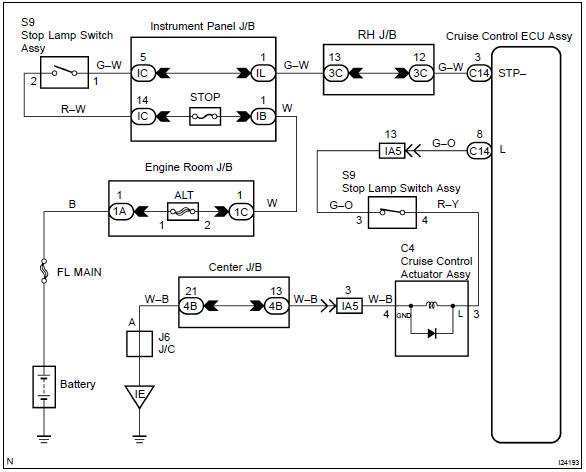
When the brake pedal is depressed, the stop lamp switch assy sends a signal to the cruise control ecu assy.
When the cruise control ecu assy receives this signal, it cancels the cruise control.
A fail–safe function is provided so that cancel functions normally, even if there is a malfunction in the stop light switch circuit.
The cancel conditions are: battery positive voltage at terminal stp–.
When the brake pedal is depressed, normal battery positive voltage normally is applied through the stop fuse and stop lamp switch assy to terminal stp– of the cruise control ecu assy, and the cruise control ecu assy turns the cruise control to off.
If the harness connected to terminal stp– has an open circuit, terminal stp– will have battery positive voltage and the cruise control will be turned off.
Also, when the brake pedal is depressed, the magnetic clutch circuit is cut mechanically by the stop lamp switch assy, turning the cruise control off.
Wiring diagram


Other materials:
Replacement
1. Remove hood sub–assy
2. Remove cylinder head cover no.2
3. Remove battery
4. Remove battery carrier
Remove the 4 bolts and battery carrier.
5. Remove air cleaner assembly with hose
6. Remove floor shift cable transmission control shift
Remove the nut from the control shaf ...
Engine coolant
The coolant level is satisfactory if it is between the “F” and “L” lines on the
reservoir when the engine is cold.
1 Reservoir cap
2 “F” line
3 “L” line
If the level is on or below the “L” line, add coolant up to the “F” line.
■Coolant selection
Only use “To ...
General information
There are many ecu controlled systems used in the corolla. In general, ecu
controlled system are considered
to be very intricate and require a high level of technical knowledge and expert
skill to troubleshoot.
The fact is, however, that if you proceed by inspecting the circuits one by one, ...