
Toyota Corolla (E120): Precaution
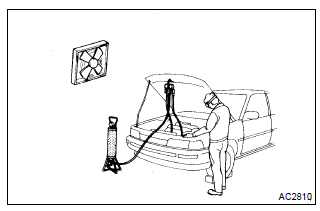
1. Do not handle refrigerant in an enclosed area or near an open flame
2. Always wear eye protection
3. Be careful not to get liquid refrigerant in your eyes or on your skin
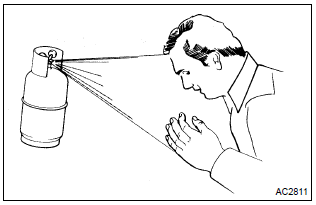
If liquid refrigerant gets in your eyes or on your skin.
- wash the area with lots of cool water.
Caution
: do not rub your eyes or skin.
- apply clean petroleum jelly to the skin.
- go immediately to a physician or hospital for professional treatment.
4. Never heat container or expose it to naked flame
5. Be careful not to drop container and not to apply physical shocks to it
6. Do not operate compressor without enough refrigerant in refrigerant system
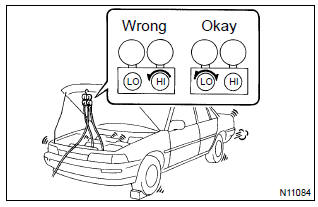
If there is not enough refrigerant in the refrigerant system oil lubrication will be insufficient and compressor burnout may occur, so take care to avoid this, necessary care should be taken.
7. Do not open high pressure manifold valve while compressor is operating
If the high pressure valves opened, refrigerant flows in the reverse direction and could cause the charging cylinder to rupture, so open and close the only low pressure valve.
8. Be careful not to overcharge system with refrigerant
If refrigerant is overcharged, it causes problems such as insufficient cooling, poor fuel economy, engine overheating etc.


Other materials:
Overhaul
Caution:
wear the gloves, because the cutting surface of the seat back frame and seat
adjuster may injure
your hand.
Hint:
tape the screwdriver tip before use when prying parts.
1. Disconnect battery negative terminal
Caution:
wait for 90 seconds after disconnecting the battery terminal a ...
Maintenance requirements
To ensure safe and economical
driving, day-to-day care
and regular maintenance
are essential. It is the
owner's responsibility to
perform regular checks.
Toyota recommends the
maintenance below.
■Repair and replacement
It is recommended that genuine
Toyota parts be used for repairs to
ensure perf ...
Pre–check
1. Pre–check
Check that the cruise control actuator assy, acceleration wire,
accelerator auto drive cable assy, and
link assy are installed correctly and that the wire and link are securely
connected.
check that the operating movement of the acceleration pedal, cruise
control actu ...