
Toyota Corolla (E120): Overhaul
1. Drain clutch fluid
2. Disconnect clutch release cylinder to flexible hose tube
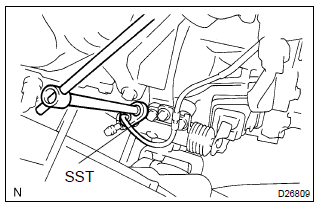
- Using sst, disconnect the flexible hose tube.
Sst 09023–00100
Hint
: use a container to catch the fluid.
3. Remove clutch release cylinder assy
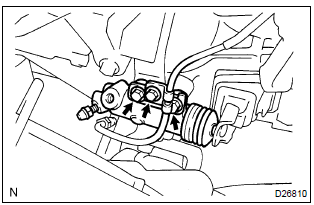
- Remove the 3 bolts, clutch release cylinder assy and clutch line bracket.
4. Remove clutch release cylinder kit
- remove the boot from the cylinder body.
- remove the push rod from the cylinder body.
- remove the piston from the cylinder body.
Notice
: be careful not to damage the inside of the cylinder body.
- remove the spring from the cylinder body.
- remove the bleeder plug cap from the bleeder plug.
5. Remove release cylinder bleeder plug
6. Install release cylinder bleeder plug
torque: 8.4 Nvm (85 Kgf·cm, 74 in.Vlbf)
7. Install clutch release cylinder kit
- Install the bleeder plug cap to the bleeder plug.
- install a new spring to the cylinder body.
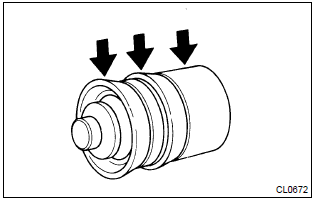
- coat parts with lithium soap base glycol grease, as shown in the illustration.
- install the piston to the cylinder body.
Notice
: be careful not to damage the inside of the cylinder body.
- install the push rod to the cylinder body.
- install the boot to the cylinder body.
8. Install clutch release cylinder assy
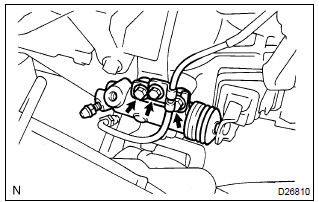
- Install the clutch release cylinder and clutch line bracket
with the 2 bolts.
Torque: 11.8 Nvm (120 Kgf·cm, 9 ft·lbf)
- install the flexible hose tube with the bolt.
Torque: 5.0 Nvm (51 Kgf·cm, 44 in.Vlbf)
9. Connect clutch release cylinder to flexible hose tube
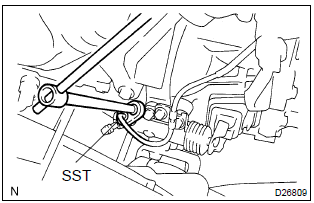
- Using sst, connect the flexible hose tube.
Sst 09023–00100
torque: 15.2 Nvm (155 Kgf·cm, 11 ft·lbf)
10. Bleed clutch pipe line
- fill the brake reservoir tank with brake fluid and bleed clutch
system.
Torque: 8.4 Nvm (85 Kgf·cm, 74 in.Vlbf)
11. Check clutch fluid leakage


Other materials:
Replacement
1. Remove hood sub–assy
2. Remove cylinder head cover no.2
3. Remove battery
4. Remove battery carrier
Remove the 4 bolts and battery carrier.
5. Remove air cleaner assembly with hose
6. Remove floor shift cable transmission control shift
Remove the nut from the control shaf ...
Evap monitor (vacuum pressure monitor)
Notice:
a cold soak must be performed prior to conducting the drive pattern to complete
the internal pressure
readiness monitor.
Cold soak preconditions
The monitor will not run unless:
mil is off.
Fuel level is approximately 1/2 to 3/4.
Altitude is 7800 feet (2400 m) or less.
...
Overhaul
1. Remove roof headlining assy
2. Remove sliding roof glass sub–assy
using a torx wrench (t25), remove the 4 screws the sliding roof
glass.
pull the glass upward to remove it.
3. Remove sliding roof weatherstrip
4. Remove sliding roof drive gear sub–assy
Notice:
...