
Toyota Corolla (E120): Fail–safe chart
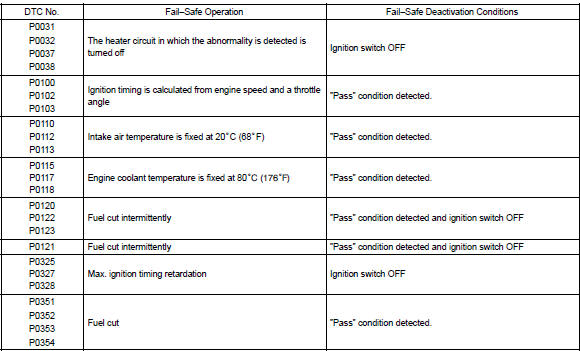
If any of the following codes is recorded, the ecm enters the fail–safe mode.
Check for intermittent problems
Hand–held tester only:
by putting the vehicle’s ecm in the check mode, the 1 trip detection logic is possible instead of the 2 trip detection logic, and the sensitivity to detect faults is increased. This makes it easier to detect intermittent problems.
- Clear the dtcs .
- set the check mode .
- perform a simulation test .
- check the connector and terminal .
- wiggle the harness and connector


Other materials:
Eco Driving Indicator Light customization (except vehicles with a manual transmission)
Eco Driving Indicator Light can be activated or deactivated.
1 While the odometer is being displayed, press and hold the “DISP” switch to
display the Eco Driving Indicator Light customization screen.
2 Press the “DISP” switch to set Eco Driving Indicator Light to on or off.
3 Press and ...
Circuit description
When a misfire occurs in the engine, hydrocarbons (hc) enter the exhaust in
high concentrations. If this hc
concentration is high enough, there could be an increase in exhaust emissions
levels. High concentrations
of hc passing through the catalyst also cause to temperature of the catalyst to ...
Driving monitor
■ Switching the display
Items displayed can be switched by pressing the “DISP” switch.
■ Average fuel consumption
Displays the average fuel consumption since the function was reset.
• Press and hold the “DISP” switch to reset when the average fuel consumption
is display ...