
Toyota Corolla (E120) 2002–2008 Repair Manual / Diagnostics / Sfi system / Idle air control System/ Circuit / Circuit description
Toyota Corolla (E120): Circuit description
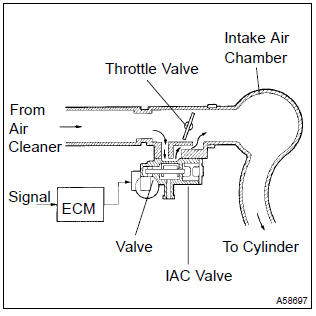
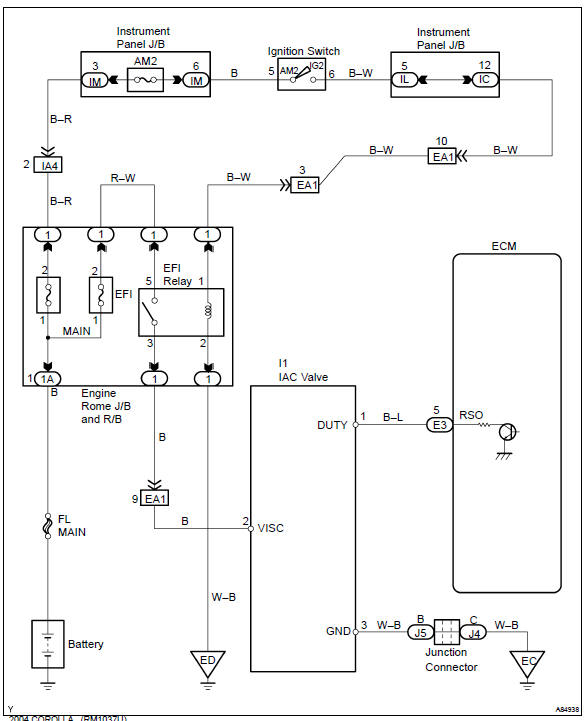
The rotary solenoid type idle air control (iac) valve is located under the throttle body and intake air bypassing the throttle valve flows into the iac valve through the passage.
In this way the intake air volume bypassing the throttle valve is regulated, controls the engine speed.
The ecm operates the iac valve only to perform idle–up and provide feedback for the target idling speed.

Monitor description
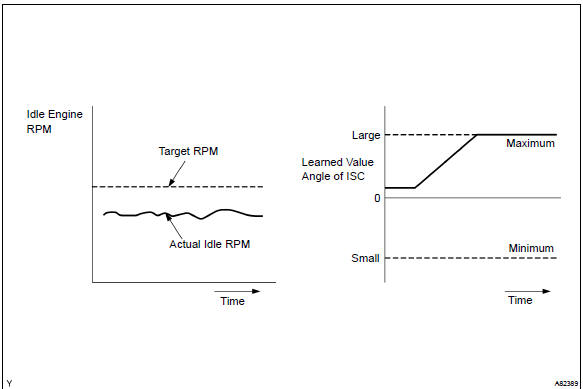
The idle speeds are determined depending on the volume of air that passes through the iac valve. When the volume is large, the idle speed becomes higher. When the volume is small, the idle speed becomes lower.
The iac valve controls the air volume that bypasses the throttle valve. The engine control module (ecm) sends duty signals to the iac valve and drives the iac valve stepper motor to determine the air volume that bypasses the throttle valve.
Although the ecm regulates the idle engine rpm with the feedback control in several vehicle stopped, actual idle rpm does not reach the targeted rpm and a learned valve angle of the idle air control (iac) remains at the maximum or remains at the minimum, the ecm determines to detect malfunction in the iac system.
Example: if the rpm difference between the targeted and actual idle engine rpms exceeds 200 rpm (*1) with the vehicle stopped in an idle, and this occurs 5 times, or if the learned value angle of the iac remains at its maximum or minimum angle for 5 seconds, p505 is detected.
P0511 is detected as an open/short circuit in the iac if the rate of duty signal input to the iac valve has stuck at 0 or 100 %.
*1: Threshold rpm is varied by an engine load.
Monitor strategy
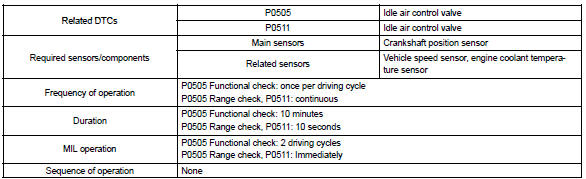
Typical enabling condition
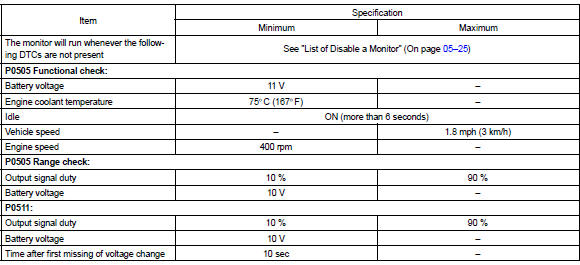
Typical malfunction thresholds
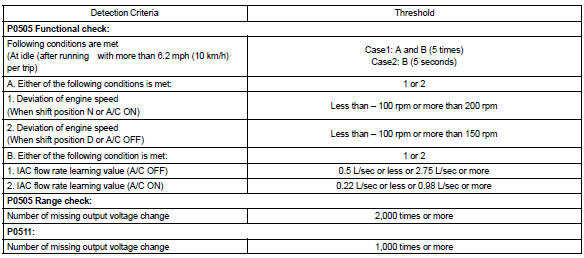
Component operating range

Wiring diagram


Other materials:
Power windows
Opening and closing the
power windows
The power windows can be
opened and closed using the
switches.
Operating the switch moves the
windows as follows:
Closing
One-touch closing*
Opening
One-touch opening*
*: To stop the window partway,
operate the switch in the opposite
direction.
■The po ...
Inspection procedure
Hint:
read freeze frame data using the hand-held tester or the obd ii scan tool.
Freeze frame data records the
engine conditions when a malfunction is detected. When troubleshooting, it is
useful for determining whether
the vehicle was running or stopped, the engine was warmed up or not, the ...
Circuit description
The fuel trim is related to the feedback compensation value, not to the basic
injection time. The fuel trim includes
the short–term fuel trim and the long–term fuel trim.
The short–term fuel trim is the short–term fuel compensation used to maintain
the air–fuel ratio at stoichiomet ...