
Toyota Corolla (E120): Brake
On–vehicle inspection
1. Inspect brake line pipes and hoses
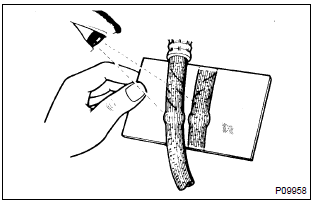
Hint
: work in a well–lighted area. Turn the front wheels fully to the right or left before begining.
- check all the brake lines and hoses for:
- damage
- wear
- deformation
- cracks
- corrosion
- leaks
- bends
- twists
- check all the clamps for tightness and the connections for leakage.
- check that the hoses and lines are not near sharp edges, moving parts and the exhaust system.
- check that the lines are installed pass through the center of the grommets.
2. Inspect front brake pads and discs
3. Inspect rear brake linings and drums
4. Inspect or change brake fluid
fluid: sae j1703 or fmvss no.116 Dot3


Other materials:
Exterior/interior trim
Preparation
Recomended tools
Equipment
Vehicle control system
Preparation
Recomended tools
...
Canceling and resuming the constant speed control
1 Pulling the lever toward you cancels the constant speed control.
The speed setting is also canceled when the brakes are applied or the clutch
pedal (manual transmission) is depressed.
2 Pushing the lever up resumes the constant speed control.
Resuming is available when the vehicle speed is mo ...
Oxygen / af sensor heater monitor
Preconditions
The monitor will not run unless:
mil is off
drive pattern
connect the obd ii scan tool to the dlc3 to check monitor status
and preconditions.
Start the engine and allow it to idle for 9 minutes.
Drive the vehicle at 25 mph (40 km ...