
Toyota Corolla (E120) 2002–2008 Repair Manual / Diagnostics / Audio system / Cassette tape cannot be inserted or played
Toyota Corolla (E120): Cassette tape cannot be inserted or played
Wiring diagram
Inspection procedure
1 Check for any foreign object
- Check for any foreign object.
- Check that no foreign object or defect is detected in the cassette
tape player of radio receiver
assembly.
Standard: no foreign object and defect detected.


2 Check cassette tape
- Check the cassette tape.
- Check that the cassette tape is a normal tape to which music or
voice is recorded.
Standard: proper cassette tape to which music or voice is recorded.


3 Replace cassette tape with another and recheck
- Replace the cassette tape with another and recheck.
- Replace the faulty cassette tape with the normal one to see if the
same trouble occurs again.
Standard: the function is recovered to be normal.


4 Check if radio auto–search functions properly
- Check if the radio auto–search functions properly.
- Perform the auto–search of the radio and check that the operation
is normal.
Standard: the operation returns to be normal.


5 Inspect radio receiver assy(+b, acc, gnd)
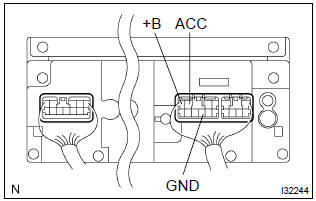
- Check that the continuity between terminals at each condition, as shown in the chart.
Standard:

- Check that the voltage between terminals at each condition, as shown in the chart.
Standard:



Repair or replace harness or connector


Other materials:
Parking brake
Operating instructions
1 To set the parking brake, fully pull the parking brake lever while depressing
the brake pedal.
2 To release the parking brake, slightly raise the lever and lower it completely
while pressing the button.
*1: For U.S.A.
*2: For Canada
■Parking brake engaged wa ...
Tire pressure warning system (if equipped)
Your vehicle is equipped with a tire pressure warning system that uses tire pressure
warning valves and transmitters to detect low tire inflation pressure before serious
problems arise.
◆ Installing tire pressure warning valves and transmitters
When replacing tires or wheels, tire press ...
Replacement
Hint: components:
1. Remove floor shift shift lever knob sub–assy
2. Remove console panel upper
3. Remove parking brake hole cover sub–assy
4. Remove console box sub–assy rear
5. Separate floor shift cable transmission control shift
Separate the end of the shift cable from the ...