
Toyota Corolla (E120): Hydraulic test
1. Perform hydraulic test
- Measure the line pressure.
Notice
:
- Do the test at normal operation atf temperature 50 to 80 °c (122 to 176 °f).
- The line pressure test should always be carried out in pairs. One technician should observe the conditions of wheels or wheel stopper outside the vehicle while the other is doing the test.
- Be careful to prevent sst’s hose from interfering with the exhaust pipe.
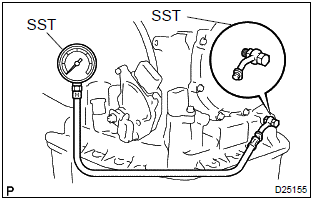
- Warm up the atf.
- Remove the test plug on the transaxle case front left
side and connect sst.
Sst 09992–00095 (09992–00231, 09992–00271)
- fully apply the parking brake and chock the 4 wheels.
- Connect an obd ii scan tool or hand–held tester to the dlc3.
- Start the engine and check the idling speed.
- Keep your left foot pressed firmly on the brake pedal and shift into the d position.
- Measure the line pressure when the engine is idling.
- Depress the accelerator pedal all the way down.
Quickly read the highest line pressure when the engine speed reaches the stall speed.
- Do the test in the r position in the same way.
Specified line pressure:

Evaluation:
|
Problem |
Possible cause |
| If the measured values at all positions are higher |
|
| If the measured values at all positions are lower |
|
| If pressure is low in the d position only |
|
| If pressure is low in the r position only |
|


Other materials:
Odometer and trip meter
display
■ Changing the display
Press the display change button
until the desired item is displayed.
■ Display items
Odometer
Displays the total distance the vehicle
has been driven.
Trip meter A/Trip meter B
Displays the distance the vehicle
has been driven since the meter
was last reset. Trip ...
Connecting a Bluetooth® audio player
► Registering an additional device
Select “Select Device” on the Bluetooth® audio control screen.
►Selecting a registered device
Select “Select Device” on the Bluetooth® audio control screen.
■Reconnecting a Bluetooth® phone
If the system cannot connect due to poor ...
Circuit description
The actuator motor is operated by signals from the cruise control ecu assy.
Acceleration and deceleration
signals are transmitted by changes in the duty ratio (see below).
Duty ratio:
the duty ratio is the ratio of the period of continuity in one cycle. For
example, if a is the period of co ...