
Toyota Corolla (E120): Circuit description
If the engine coolant temperature (ect) does not reach 75°c (167°f) despite sufficient warm – up time has elapsed.
|
Dtc no |
Dtc detection condition |
Trouble area |
| P0128 | Condition (a), (b) and (c):
|
|
Monitor description
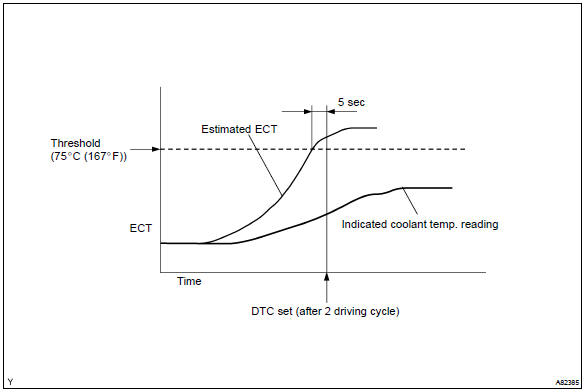
The ecm estimates the engine coolant temperature (ect) based on starting temperature, engine loads, and engine speeds. The ecm then compares the estimated ect with the actual ect. When the estimated ect reaches 75 c (167 f) the ecm checks the actual ect. If the actual ect is less than 75 c (167 f), the ecm will interpret this as a fault in the thermostat or engine cooling system or thermostat and set a dtc.
Monitor strategy

Typical enabling conditions
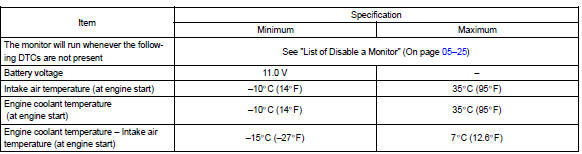
Typical malfunction thresholds

Component operating range

Monitor result (mode 06 data)

Refer to page 05–27 for the detailed information on checking monitor status.


Other materials:
Source voltage drop
The srs is equipped with a voltage–increase circuit (dc–dc converter) in the
airbag sensor assy center
in case the source voltage drops.
When the battery voltage drops, the voltage–increase circuit (dc–dc converter)
functions to increase the
voltage of the srs to normal voltage.
...
Overhaul
1. Remove console panel upper
2. Remove console box carpet
3. Remove parking brake hole cover sub–assy
4. Remove console box sub–assy rear
5. Disconnect floor shift cable transmission control shift
Remove the cable end from the rod of the floor shift assembly.
Using a s ...
Inspection procedure
1 Check security indicator light
Set the system in 30 seconds after filliping the security indicator to
check if the alarm is triggered.
2 Check glass breakage sensor ecu (glass breakage sensor)
Check the continuity and voltage of the glass breakage
sensor ecu, as shown in th ...