
Toyota Corolla (E120): Brake
On–vehicle inspection
1. Inspect brake line pipes and hoses
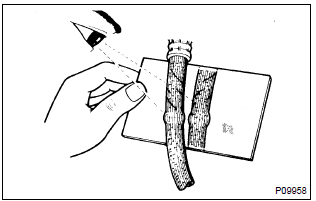
Hint
: work in a well–lighted area. Turn the front wheels fully to the right or left before begining.
- check all the brake lines and hoses for:
- damage
- wear
- deformation
- cracks
- corrosion
- leaks
- bends
- twists
- check all the clamps for tightness and the connections for leakage.
- check that the hoses and lines are not near sharp edges, moving parts and the exhaust system.
- check that the lines are installed pass through the center of the grommets.
2. Inspect front brake pads and discs
3. Inspect rear brake linings and drums
4. Inspect or change brake fluid
fluid: sae j1703 or fmvss no.116 Dot3


Other materials:
AUX port/USB port
Connect an iPod, USB memory device or portable audio player to the AUX port/USB
port as indicated below. Press to select
“iPod”, “USB” or “AUX”.
Connecting using the AUX port/USB port
■ iPod
Open the cover and connect an iPod using an iPod cable.
Turn on the power of the i ...
Circuit description
The airbag sensor assy center consists of a airbag sensor assy center, safing
sensor, drive circuit, diagnosis
circuit and ignition control, etc.
It receives signals from the airbag sensor, judges whether or not the srs must
be activated, and detects
diagnosis system malfunction.
Dtc b11 ...
Circuit description
The crankshaft position sensor (ne signal) consists of a magnet, iron core
and pickup coil.
The ne signal plate (crankshaft position sensor plate) has 34 teeth and is
installed on the crankshaft. The
ne signal sensor generates 34 signals for each engine revolution. This sensor
monitors a p ...