
Toyota Corolla (E120) 2002–2008 Repair Manual / Engine hood/door / Luggage door hinge torsion bar rh
Toyota Corolla (E120): Luggage door hinge torsion bar rh
Replacement
Hint
:
- installation is in the reverse order of the removal. But the installation is indicated only when it has a point.
- In the lh side, work in the same procedure as in the rh side.
- Since the removal of the torsion bar will cause no tension, operation of opening and closing the door should be carried out holding the door by hand in order to prevent the door from closing without any resistance.
- Rh side torsion bar is in the upper side and lh side torsion bar is in the lower side, thus the installation should be done in the order of rh to lh, and the removal should be done in the order of lh to rh.
1. Remove luggage door hinge torsion bar rh
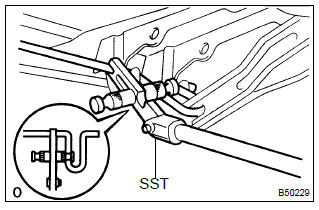
- Remove the torsion bars from the center bracket.
- install sst to the torsion bar on the hinge side.
Sst 09804–24010
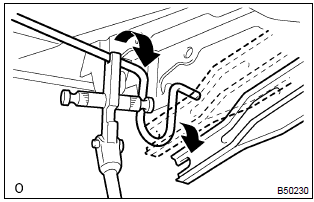
- Push down the sst, and pull the luggage compartment door hinge from the torsion bar.
- slowly lift the sst, and remove the torsion bar from the torsion bar bracket with sst.
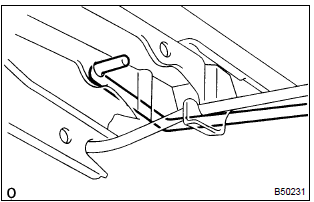
- Disconnect the torsion bar from the bracket.
- employ the same manner described above to the other side.
2. Install luggage door hinge torsion bar rh
- when installing the torsion bar, be sure to install it to the clamp securely.


Other materials:
Sound quality is bad only when playing tape
Inspection procedure
1 Replace cassette tape with another and recheck
Replace the cassette tape with another and recheck.
Replace the faulty cassette tape with the normal one to see if the
same trouble occurs again.
Standard: malfunction disappear.
2 Check for any foreig ...
Adjustment
1. Inspect and adjust clutch pedal sub–assy
Turn over the floor carpet.
check that the pedal height is correct.
Pedal height from asphalt sheet:
135.8 – 145.8 Mm (5.346 – 5.740 In.)
adjust the pedal height.
Loosen the lock nut and turn the stopper bolt until
...
Listing the registered portable players
Select “List Audio” using .
The list of registered portable players will be displayed.
● Connecting the registered portable player to the audio system
1 Select the name of the portable player to be connected using
.
2 Select “Select” using .
● Deleting the registered ...