
Toyota Corolla (E120) 2002–2008 Repair Manual / Diagnostics / ABS with EBD system / Malfunction in abs ecu / Inspection procedure
Toyota Corolla (E120): Inspection procedure
1 Reconfirm dtc
- Check the dtc


2 Inspect skid control ecu connector securely connected


3 Inspect skid control ecu connector(ig1 terminal voltage)
In case of using hand–held tester:
- check the voltage condition output from the ecu displayed on the
hand–held tester.
Ok: ”normal” is displayed.
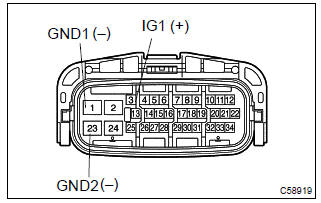
In case of not using hand–held tester:
- disconnect the skid control ecu connector.
- turn the ignition switch to on.
- measure voltage between terminals ig1 (3) and gnd (1,
23) of skid control ecu harness side connector.
Ok: oltage: 10 – 14 v


4 Inspect skid control ecu connector(gnd terminal continuity)
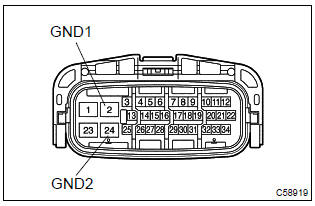
- Measure resistance between terminal gnd (s1–2, 24) of
skid control ecu harness side connector and body
ground.
Resistance: 1 Ω or less


Check and repair harness and connector
5 Go to combination meter system(abs warning light)
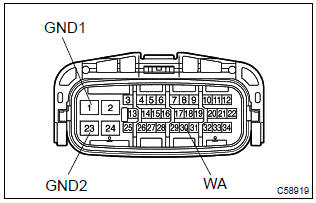
- Disconnect the skid control ecu connector.
- using service wire, connect terminals wa (30) and gnd (1, 23) of skid control ecu harness side connector.
- turn the ignition switch to on.
Ok: abs warning light goes off.


Check and replace brake actuator assy


Other materials:
Switching the display
Press to display or hide the album
title.
If there is additional text, is
displayed.
Press and hold to display the remaining
text.
■USB memory functions
●Depending on the USB memory that is connected to the system, the device itself
may not be operable and certain function ...
Manual shifting test
1. Perform manual shifting test
Hint:
by this test, it can be determined whether the trouble is within
the electrical circuit or is a mechanical problem in the transaxle.
Disconnect the transmission wire connector.
inspect the manual driving operation.
Check that the shift and g ...
Outside temperature display
The temperature display shows temperatures within the range of -40°F (-40°C)
to 122°F (50°C).
► Type A
► Type B
► Type C
► Type D
■The outside temperature is displayed when
►Vehicles without a smart key system
The engine switch is in the “ON ...