
Toyota Corolla (E120) 2002–2008 Repair Manual / Diagnostics / Audio system / Diagnostic trouble code chart
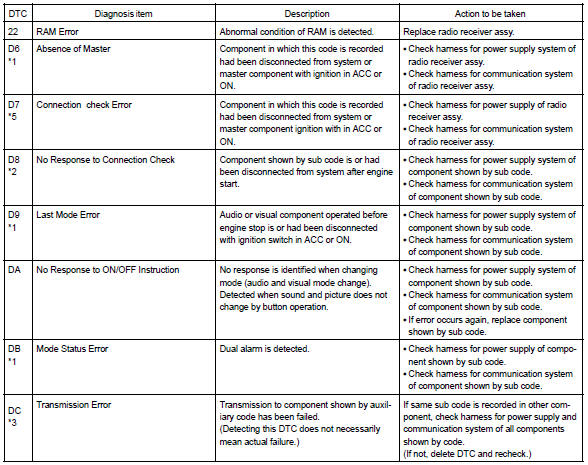
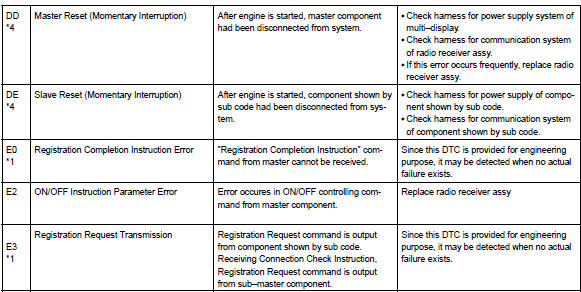
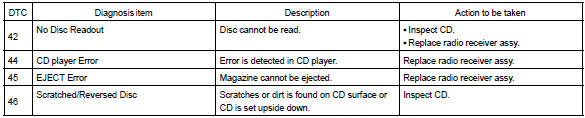
Toyota Corolla (E120): Diagnostic trouble code chart
|
Terms |
Terms |
| Physical address | Three–digit code (shown in hexadecimal) which is given to each
component comprising
the avc–lan.
Corresponding to the function, individual symbols are specified. |
| Logical address | Two–digit code (shown in hexadecimal) which is given to each function comprising the inner system of the avc–lan. |
1. Radio receiver assy (physical address: 190)
Hint
: *1: even if no failure is detected, it may be stored depending on the battery condition or voltage for starting an engine.
*2: It is stored when 180 sec. Has passed after the power supply connector is pulled out after engine start.
*3: It may be stored when the engine key is turned 1 min. After engine start.
*4: It may be stored when the engine key is turned again after engine start.
*5: When 210 sec. Has passed after pulling out the power supply connector of the master component with the ignition switch in acc or on, this code is stored.
- Logical address: 01 (communication control)
- Logical address: 61 (cassette switch)

- Logical address: 62 (cd player)
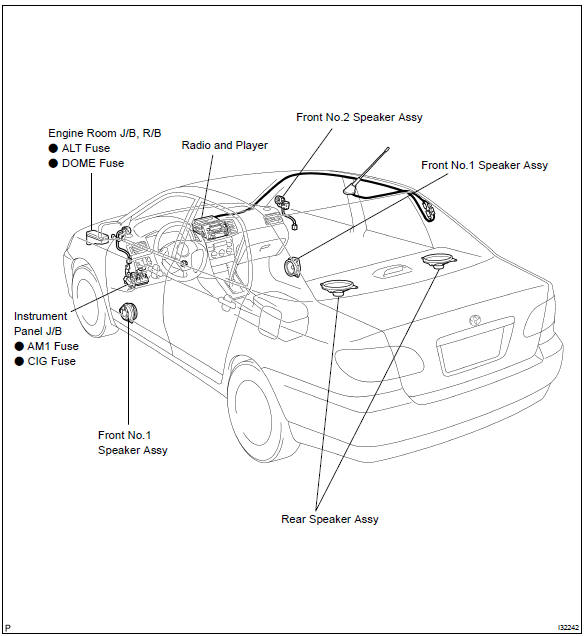
Location


Other materials:
Circuit description
The airbag sensor front lh circuit consists of the airbag sensor assy center
and airbag sensor front lh.
Dtc b1158/b1159/16 is recorded when malfunction is detected in the airbag sensor
front lh circuit.
Wiring diagram
...
Steering wheel
Adjustment procedure
1. Hold the steering wheel and
push the lever down.
2. Adjust to the ideal position by
moving the steering wheel
horizontally and vertically.
After adjustment, pull the lever up
to secure the steering wheel.
WARNING
■Caution while driving
Do not adjust the steering wheel
wh ...
Toyota vehicle intrusion protection system
On–vehicle inspection
1. Outline of toyota vehicle intrusion protection (tvip) system
Hint:
the theft deterrent system has 2 modes; one is the active mode that is an
initially set mode and another is
the passive mode that can be switched on/off by the specified method (see step
4).
&nb ...