
Toyota Corolla (E120) 2002–2008 Repair Manual / Introduction / How to troubleshoot ecu controlled
systems / Customer problem analysis
Toyota Corolla (E120): Customer problem analysis
Hint
:
- in troubleshooting, the problem symptoms must be confirmed accurately, meaning that all preconceptions must be set aside in order to make an accurate judgement. To ascertain what the problem symptoms are, it is extremely important to ask the customer about the problem and conditions when it occurred.
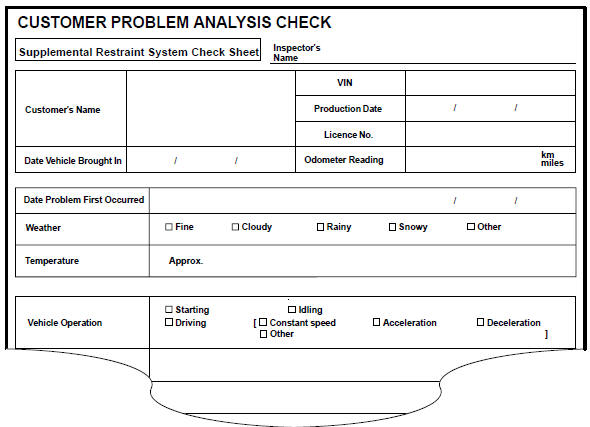
- The following 5 items are important points in the problem analysis. Past problems which are thought to be unrelated and the repair history, etc. May also help in some cases. Therefore, as much information as possible should be gathered and its relationship with the problem symptoms should be correctly ascertained for use as reference in troubleshooting. A customer problem analysis table is provided for your use in the diagnostics section for each system.

(Sample) supplemental restraint system check sheet.


Other materials:
Disposal
Hint:
when scrapping vehicle equipped with an srs or disposing of a instrument panel
passenger airbag assy,
always first deploy the airbag in accordance with the procedure described below.
If any abnormality occurs
with the airbag deployment, contact the service dept. Of toyota motor sales,
...
Engine oil
With the engine at operating temperature and turned off, check the oil level
on the dipstick.
■ Checking the engine oil
1 Park the vehicle on level ground. After warming up the engine and turning it
off, wait more than 5 minutes for the oil to drain back into the bottom of the engine.
2 ...
Replacement
Hint: components:
1. Precaution
2. Disconnect battery negative terminal
3. Remove instrument panel sub–assy lower
Remove the screw from the glove compartment door
stopper sub–assy.
pull the instrument panel sub–assy lower to remove it.
4. Separate passenger airbag co ...