
Toyota Corolla (E120) 2002–2008 Repair Manual / Diagnostics / Sfi system / Readiness monitor drive pattern / Catalyst monitor (o2s type)
Toyota Corolla (E120): Catalyst monitor (o2s type)
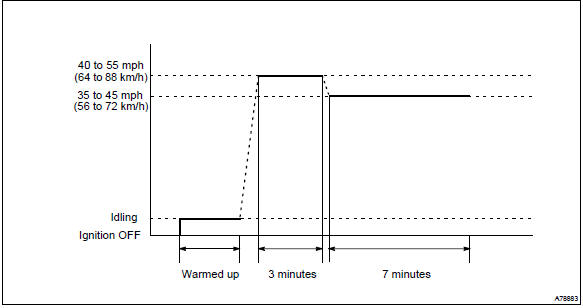
- Preconditions
The monitor will not run unless:
- mil is off.
- Engine coolant temperature (ect) is 176°f (80 °C) or greater.
- Intake air temperature (iat) is 14°f (–10 °C) or greater.*
Notice
: * 2002 and later my vehicles: the readiness test can be completed in cold ambient conditions (less than 14°f / –10 °C), if the drive pattern is repeated a second time after cycling the ignition off.
- Drive pattern
- connect the obd ii scan tool to the dlc3 to check monitor status and preconditions.
- Drive the vehicle at 40 to 55 mph (64 to 88 km/h) for approximately 3 minutes.
Notice
: drive with smooth throttle operation and avoid sudden acceleration.
If iat is less than 50°f (10 °C) when starting engine, continue to drive vehicle at 40 to 55 mph (64 to 88km/h) for approximately 4 minutes.
- Drive the vehicle at 35 to 45 mph (56 to 72 km/h) for approximately 7 minutes.
Notice
: drive with smooth throttle operation and avoid sudden deceleration as much as possible with the throttle fully closed.
- If readiness status dose not switch to complete, make sure that the preconditions are met and the ignition switch is turned off and then repeat steps (2) and (3).
- Release pressure in the fuel tank by removing and then reinstalling the fuel tank cap.
- Start the engine and immediately begin driving as directed.


Other materials:
Listening to an iPod
Connecting an iPod enables you to enjoy music from the vehicle speakers.
Select “iPod” on the audio source selection screen.
When the iPod connected to the system includes iPod video, the system can only
output the sound by selecting the browse screen.
Connecting an iPod
Audio control scre ...
How to proceed with troubleshooting
Troubleshoot in accordance with the procedure on the following pages.
1 Vehicle brought to workshop
2 Customer problem analysis check and symptom check
Without applicable symptoms, proceed to ”a”.
with applicable symptoms, proceed to ”b”.
3 Symptom simulation
4 Prob ...
Switches
Instrument panel light control dial
Automatic High Beam switch
Heated steering wheel switch*
Windshield wiper de-icer switch*
Outside rear view mirror switch
Door lock switches
Power window switches
Window lock switch
*: If equipped
Meter control switches
Paddle shift switches*1
C ...